Beth Smith, M. Ed. | #smithingifted | Gifted Education • STEM • Robotics • Critical Thinking
What happens when you give a gifted student a robot, a challenge, and the freedom to figure things out?
You get much more than coding.
You get problem-solving, critical thinking, mathematical reasoning, creativity, perseverance, and sometimes a healthy dose of frustration!
As a gifted teacher, I am always looking for learning experiences that move beyond simply keeping students busy. Gifted students need opportunities to think deeply, tackle complex problems, test ideas, and learn that getting something wrong is often the beginning of real learning.
That’s why VEX Robotics deserves a place in the gifted classroom.

And here’s the exciting part: You don’t even need a physical robot to get started!
Meet VEXcode VR: Robotics Without the Robot
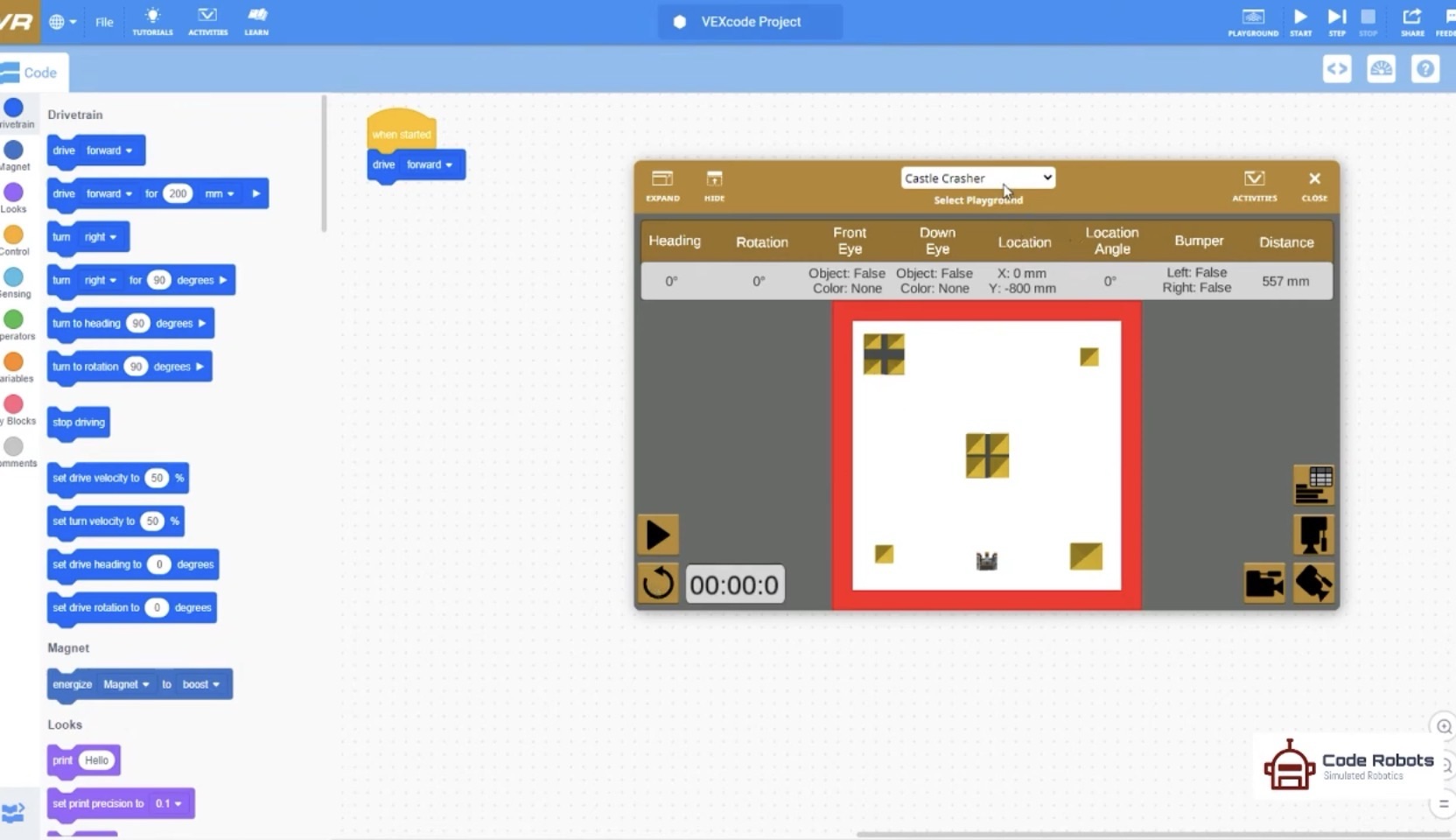
VEXcode VR is a browser-based platform that allows students to program a virtual robot to complete challenges in interactive environments called Playgrounds.
Students can navigate mazes, draw geometric designs, solve movement challenges, and experiment with coding concepts.
The free version provides an excellent starting point, with additional environments and capabilities available through paid licenses.
For gifted classrooms with limited budgets, shared robotics equipment, or students working at different skill levels, this opens up exciting possibilities.
But the real value isn’t the technology. It’s the thinking that happens when students use it.
1. Gifted Students Need Challenges Without Obvious Answers
Many gifted students are accustomed to finding the correct answer quickly.
Robotics changes that experience.
A student might program a robot to move through a maze, only to discover that the robot turns too early, travels too far, or completely misses the destination.
Now what?
The student must analyze the problem, evaluate the code, make adjustments, and test again.
There may be several successful solutions, but some are more efficient than others.
This creates opportunities for higher-level questions:
- Can you solve the challenge using fewer commands?
- What happens if the environment changes?
- Can your robot complete the task independently using sensors?
- Can you explain why your algorithm works?
- How could you improve your solution?
These questions move students beyond completing a task and into analyzing, evaluating, and creating.
2. Robotics Makes Mathematical Thinking Visible
One of my favorite things about robotics is the natural connection to mathematics.
Students aren’t simply memorizing angles, measuring distances, or following directions.
They’re using mathematical concepts to accomplish a purpose.
Imagine challenging students to program a robot to navigate a square.
Students must consider angles, distance, direction, and repeated patterns.
Then increase the complexity.
Can they create a triangle? A hexagon? A more complicated geometric design?
Can they use loops instead of repeating commands?
Suddenly, mathematical concepts become tools for solving problems.
For gifted learners who have already mastered grade-level mathematics, robotics offers a meaningful way to apply, deepen, and extend their understanding.
3. Differentiation Happens Through Complexity
One challenge in gifted education is that students do not all have the same strengths, interests, or coding experience.
Some students are just discovering sequencing. Others may already understand loops, conditional statements, and sensors.
VEXcode VR allows us to offer different levels of complexity while working toward a shared learning goal.
For example:
BUILD: Program the robot to move forward and turn.
MASTER: Navigate a predefined route accurately.
DEEPEN: Complete the same route using fewer commands or reusable patterns.
ACCELERATE: Create an algorithm that uses sensor feedback to respond to changes in the environment.
The goal isn’t to give advanced students more work.
The goal is to give them more sophisticated thinking.
That’s what meaningful gifted differentiation should look like.
4. Robotics Teaches Something Gifted Students Desperately Need: Productive Struggle
Let’s talk about perfectionism.
Some gifted students become uncomfortable when they don’t immediately know how to solve something.
Robotics gives us opportunities to change that mindset.
When a robot doesn’t follow the intended path, the program has provided feedback.
Students must debug, revise, and try again.
I want students to understand that an unsuccessful attempt is not the same as being unsuccessful.
It is information.
Instead of asking, “Did you get it right?” we can ask:
“What did you learn from your first attempt?”
“What evidence tells you where the problem occurred?”
“What will you change next?”
These conversations build perseverance, self-regulation, and confidence in tackling unfamiliar problems.
5. Coding Encourages Computational Thinking
VEX Robotics naturally introduces important computational thinking skills:
- Decomposition: Breaking complicated challenges into manageable steps.
- Pattern Recognition: Identifying repeated movements or commands.
- Abstraction: Focusing on the information needed to solve the problem.
- Algorithm Design: Creating a logical sequence of instructions.
- Debugging: Identifying and correcting errors.
These skills extend well beyond computer science.
They support mathematical reasoning, scientific investigations, engineering design, and everyday problem-solving.
When students learn to think computationally, they are learning to approach complex problems systematically.
6. From Virtual Robotics to Real-World Engineering
VEXcode VR provides an accessible starting point, but I also see tremendous value in moving students from virtual coding into physical robotics when equipment is available.
Virtual environments allow students to focus on programming concepts without spending instructional time on batteries, construction, or equipment issues.
Physical VEX robots add another layer of engineering complexity.
Students must consider design, friction, wheel movement, hardware limitations, and the differences between simulated and real-world performance.
Imagine students developing an algorithm virtually, predicting how it will perform with a physical robot, and then testing their assumptions.
Now we’re connecting computer science, mathematics, engineering, and scientific investigation.
That’s powerful learning!
Bringing VEXcode VR Into the #smithingifted Classroom
Here’s a challenge I would use with my gifted students:
The Autonomous Rescue Mission
Students are robotics engineers responsible for designing a program that guides a virtual robot through a simulated disaster zone.
Their mission is to navigate obstacles, reach a designated rescue location, and return safely.
Students must:
- Develop an initial navigation plan.
- Create and test their code.
- Record unsuccessful attempts and adjustments.
- Improve the efficiency of their algorithm.
- Explain their programming decisions using evidence.
For students ready for an additional challenge, introduce changing conditions, sensor-based decisions, or restrictions on the number of commands.
I wouldn’t assess students solely on whether their robot reached the destination.
I would assess their reasoning, persistence, revisions, and ability to explain their solution.
Because the most important product isn’t the robot’s movement. It’s the student’s thinking.
My Final Thoughts: A Robot Is Not a Curriculum
Putting a robot in front of students doesn’t automatically create meaningful STEM instruction.
Neither does opening a coding website and letting students explore without a learning purpose.
The value comes from intentional instruction, carefully designed challenges, meaningful differentiation, and opportunities for students to reflect on their thinking.
VEX Robotics provides a powerful tool for creating those experiences.
But the teacher creates the learning.
For gifted students, robotics should be more than an engaging activity.
It should be an opportunity to investigate, question, design, struggle, revise, and solve increasingly complex problems.
And that is exactly the kind of learning I want happening in my gifted classroom.
Ready to explore?
Try VEXcode VR: https://vr.vex.com/
Explore more gifted STEM, coding, and robotics learning opportunities through the #smithingifted Learning & Innovation Lab.
#smithingifted #GiftedEducation #VEXRobotics #VEXcodeVR #STEMEducation #GiftedAndTalented #ComputationalThinking #RoboticsInEducation #ProblemBasedLearning