By Beth Smith, M. Ed.. | #smithingifted
A student releases the first marble.
It rolls down the board, hits a ramp, changes direction—and completely misses the path the student expected it to take.
The student looks at the board.
Then at me.
Then back at the board.
“It didn’t work.”
This is the moment when teachers are tempted to step in. We can often see the misplaced piece immediately. We know that one small change will solve the problem. It would be faster to point to the error, move the piece, and let the student try again.
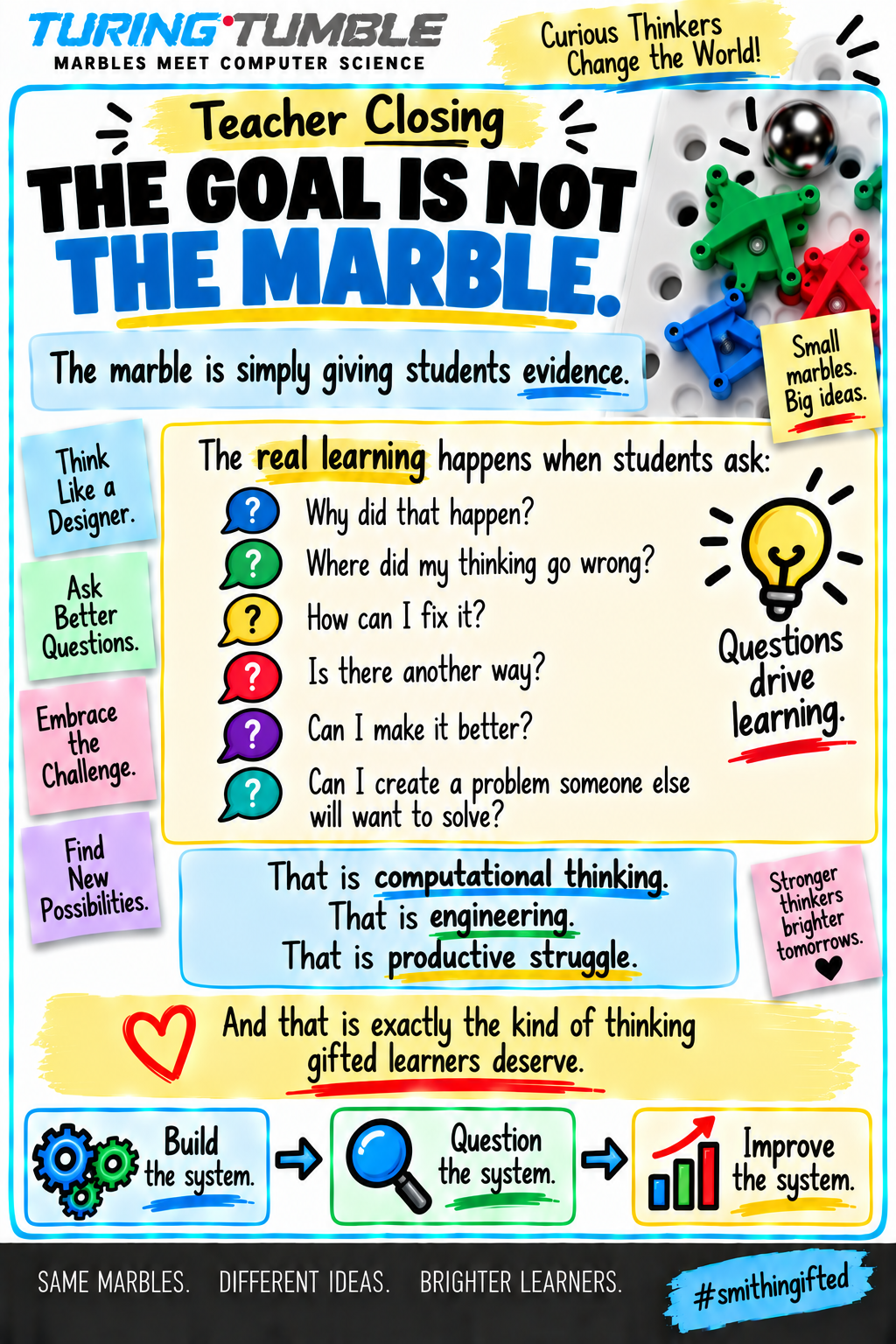
But the goal is not the marble.
The marble is simply giving the student evidence.
When the Program Fails, the Thinking Begins
Turing Tumble allows students to build mechanical computers using ramps, crossovers, bits, gears, gear bits, and colored marbles. Students create a system, release a marble, and watch their program run in real time.
Sometimes it works.
Often, it does not.
That failure is not an interruption to the learning. It is where some of the most valuable learning begins.
When a marble travels in an unexpected direction, students must slow down and ask:
- What did I predict would happen?
- What actually happened?
- Where did the marble’s path change?
- Which part of the system caused that change?
- What could I adjust without rebuilding everything?
These questions move students beyond simply completing a puzzle. They begin thinking like programmers, engineers, and problem-solvers.
Productive Struggle Requires More Than Persistence
We often tell students to “keep trying,” but productive struggle is not the same as repeating the same attempt over and over.
Productive struggle requires students to use evidence.
With Turing Tumble, the evidence is visible. Students can watch the marble move through each part of their program. They can identify where the outcome stopped matching their prediction. They can revise one piece, test again, and compare the new result with the old one.
The process becomes:
Predict. Test. Observe. Debug. Revise. Explain.
That cycle develops computational thinking, but it also strengthens skills gifted learners need in every subject.
Students practice:
- tolerating uncertainty
- revising an idea without abandoning it
- explaining cause and effect
- considering more than one possible solution
- learning from an unsuccessful attempt
- defending their reasoning with evidence
These habits matter far beyond robotics or computer science.
The Hardest Part Is Not Fixing the Board
For some gifted students, the most difficult part of Turing Tumble is not solving the challenge. It is dealing with the fact that their first solution did not work.
Students who are accustomed to quick success may interpret an incorrect result as proof that they are not good at something. Others may immediately dismantle the entire board, make several random changes, or ask an adult to tell them what to do.
That is why the teacher’s response matters.
Instead of saying, “Move this piece over here,” try asking:
- “What did the marble show you?”
- “Where did the program behave differently from your prediction?”
- “Which single piece could you test first?”
- “What do you know now that you did not know before the test?”
- “Can you explain the problem without fixing it yet?”
These questions return the thinking to the student.
Try a “Failure Detective” Pause
Before students change their boards, have them complete a short Failure Detective response:
What happened?
Describe what the marble actually did.
Why do you think it happened?
Identify the piece or sequence that may have caused the result.
What will you change?
Choose one specific revision to test next.
The key is requiring students to name the planned change before touching the board.
This pause prevents random rebuilding and encourages intentional debugging. It also gives teachers a quick way to see whether students understand the system or are simply guessing.
For an added challenge, ask students to predict how their revision will affect the rest of the program.
Make the Thinking Visible
A successful Turing Tumble board is exciting, but the finished board does not show the full learning process.
The real story is found in the revisions:
- the prediction that turned out to be incorrect
- the evidence students noticed
- the disagreement between partners
- the piece they decided to test
- the solution they rejected
- the explanation they developed after trying again
Consider having students keep a simple debugging record or take photos of different versions of their builds. Ask them to explain not only how the final program works, but also how their thinking changed.
A student who can explain why a program failed may demonstrate deeper understanding than a student who reached the correct solution quickly.
Do Not Rescue the Marble Too Soon
Turing Tumble reminds us that students do not need every challenge removed from their path.
They need meaningful problems, time to investigate, permission to revise, and questions that help them think more deeply.
The goal is not to prevent frustration. The goal is to help students learn what to do with frustration.
So, when the marble goes the wrong way, pause before stepping in.
Let students observe.
Let them question.
Let them debug.
Let them discover that an unsuccessful attempt is not the end of the problem—it is new information.
Because the goal is not the marble.
The goal is building students who can question a system, improve a system, and keep thinking when the first solution does not work.
What do you say or do when a student’s first solution fails? Share your favorite productive-struggle prompt in the comments.
#smithingifted