By Beth Smith, M. Ed. | #smithingifted
Have you ever asked your class a thoughtful question, only to hear from the same three students while everyone else waits quietly for the discussion to end?
Creating meaningful student-led discussions sounds simple, but it takes more than placing students in a circle and asking an open-ended question. Students need clear expectations, discussion strategies, academic language, accountability, and plenty of practice.
That is where Socratic Seminars can completely transform classroom learning.
What Is a Socratic Seminar?
A Socratic Seminar is a structured discussion in which students explore an important question, text, problem, or topic together.
Instead of waiting for the teacher to provide the correct answer, students learn to:
- ask thoughtful questions
- explain their reasoning
- support ideas with evidence
- listen carefully to others
- consider different perspectives
- respectfully agree or disagree
- build upon a classmate’s thinking
The teacher becomes the facilitator rather than the center of the conversation.
When students are given the right tools, the classroom begins to sound less like a question-and-answer session and more like a community of thinkers.
Why Socratic Seminars Work So Well With Gifted and Advanced Learners
Gifted learners often have strong opinions, unusual connections, and questions that go far beyond the surface of a lesson. They need opportunities to explore ideas that may not have one obvious answer.
Socratic Seminars create space for that deeper thinking.
Students are encouraged to examine assumptions, defend their reasoning, challenge ideas respectfully, and revise their thinking when they encounter new evidence.
The goal is not simply to prove that one person is right. The goal is to leave the discussion with a stronger understanding of the topic.
This makes Socratic Seminars especially powerful in gifted education, enrichment classes, honors programs, inquiry-based classrooms, and project-based learning.
Socratic Seminars Can Work Across the Curriculum
One of the greatest strengths of the Socratic Seminar format is its flexibility. It can be used with almost any text, topic, project, or real-world problem.
In English Language Arts
Students might discuss:
- whether a character made the right decision
- how an author develops a theme
- which piece of evidence best supports an interpretation
- whether the ending of a story was fair
- how two texts present different perspectives
In Social Studies
Students might explore:
- whether historical decisions were justified
- how geography influences communities
- whether a government action was fair
- which historical source is most trustworthy
- how the past continues to affect the present
In Science and STEM
Students might consider:
- whether new technology creates more benefits or problems
- how communities should respond to environmental challenges
- whether scientific progress should have limits
- which engineering solution best meets the criteria
- who should be responsible for protecting natural resources
In Project-Based Learning
A Socratic Seminar can help students reflect on:
- what they learned
- which solutions were most effective
- what evidence influenced their decisions
- how well their team collaborated
- what they would change during the next design cycle
The format stays consistent while the content changes, making it a reusable classroom routine rather than a one-time activity.
The Biggest Challenge Is Teaching Students How to Discuss
Students are not automatically prepared to participate in a productive academic conversation.
Some students dominate the discussion. Others hesitate to speak. Some repeat an idea without adding anything new. Others disagree without explaining why.
That does not mean the seminar failed. It means students need explicit instruction and support.
Before beginning, students should understand how to:
- enter a conversation appropriately
- refer to a text or source
- ask a follow-up question
- paraphrase another speaker
- build on an idea
- disagree respectfully
- invite another student into the discussion
- reflect on their own participation
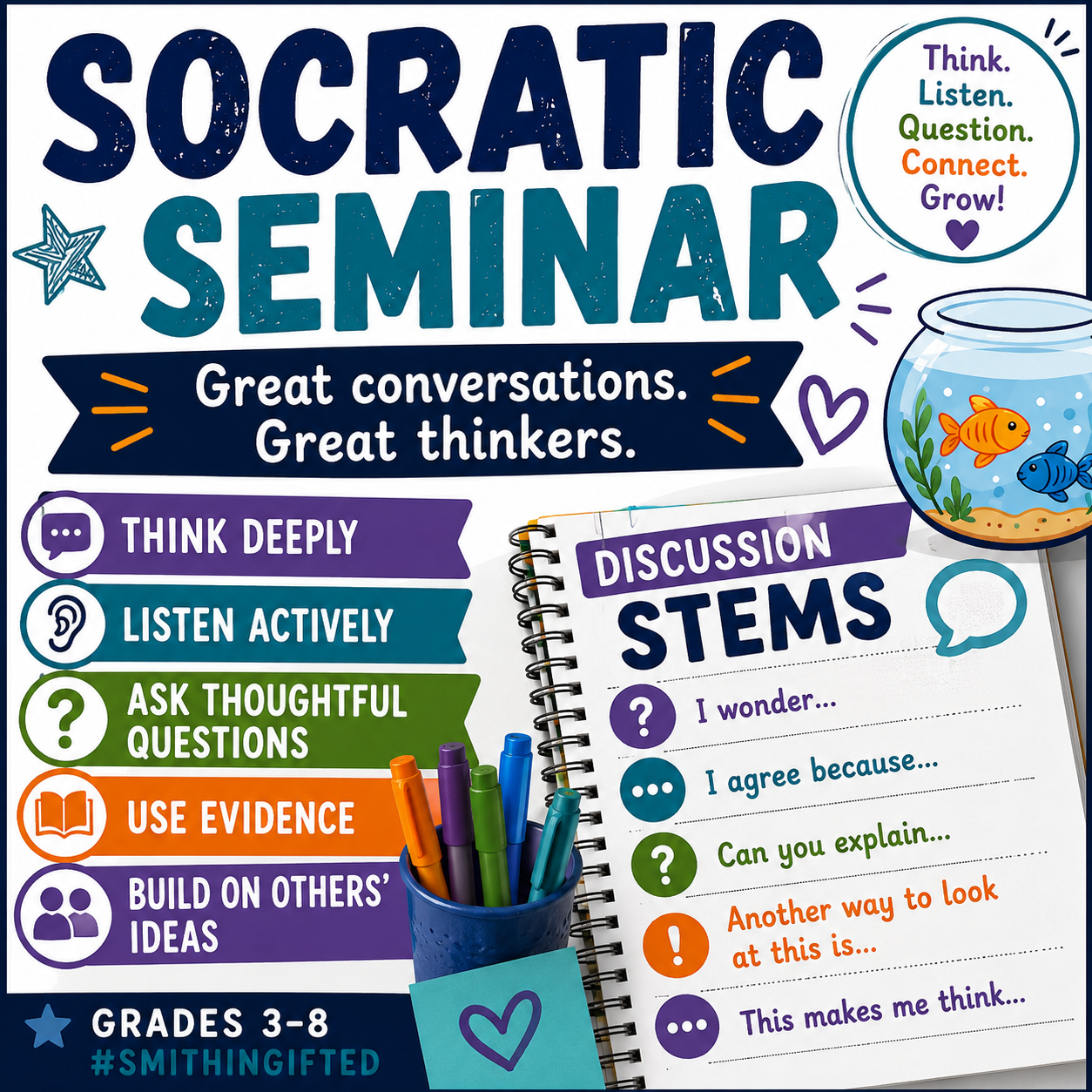
Sentence stems can be especially helpful.
Students might say:
- “I agree with that idea because…”
- “I see it differently because…”
- “What evidence supports that conclusion?”
- “I would like to add to what ___ said…”
- “Another perspective might be…”
- “My thinking changed when…”
These supports are not scripts that limit students. They are tools that help students develop the language of academic conversation.
Accountability Makes the Discussion More Meaningful
A successful Socratic Seminar should include more than speaking.
Students can take notes, record evidence, set participation goals, observe a partner, complete a self-assessment, or reflect on how their thinking changed.
Accountability tools help students recognize that strong participation includes:
- listening
- preparing
- asking questions
- referring to evidence
- encouraging others
- making meaningful contributions
- reflecting honestly
This is particularly important for students who may not speak frequently but are still deeply engaged in the discussion.
A student who carefully tracks ideas, makes one insightful connection, and writes a strong reflection may demonstrate more meaningful participation than a student who speaks repeatedly without adding depth.
Try the Fishbowl Format
For classes that are new to Socratic Seminars, a Fishbowl discussion can be an excellent starting point.
A smaller group sits in the center and participates in the seminar. The remaining students observe from the outside.
Observers can look for:
- evidence-based responses
- respectful disagreement
- strong questions
- active listening
- students building on one another’s ideas
- balanced participation
Afterward, students switch roles or discuss what they noticed.
The Fishbowl format allows students to see what an effective discussion looks and sounds like before they are expected to participate independently.
A Ready-to-Use Socratic Seminar System
To make implementation easier, I created the Socratic Seminar Ultimate Bundle | Growing Bundle for Grades 3–8.

The collection includes resources for introducing, facilitating, assessing, and differentiating Socratic Seminars. Teachers receive student instructions, discussion norms, roles, sentence stems, note-taking pages, observation forms, rubrics, reflection pages, evidence supports, facilitation guidance, and strategies for whole-class, small-group, one-on-one, and Fishbowl discussions. (Teachers Pay Teachers)

The materials can be used across English language arts, reading, gifted education, social studies, science, STEM, and project-based learning. They are designed to work with different texts and topics, allowing teachers to build a consistent discussion routine across the school year. (Teachers Pay Teachers)
Why It Is a Growing Bundle
This resource is designed to continue expanding.
Teachers who purchase the growing bundle receive the current materials along with future additions and updates at no additional cost. Planned additions include reading-skill discussion cards, fiction and nonfiction question sets, historical document seminars, science and STEM seminar packs, debate materials, digital resources, editable templates, advanced units, and middle-school extensions. (Teachers Pay Teachers)
As more resources are added, the bundle can become a complete classroom system for academic discussion rather than a collection of disconnected activities.
Start Small and Build the Routine
Your first Socratic Seminar does not need to be perfect.
Begin with a short text, one strong question, a few clear discussion expectations, and a brief reflection.
After each seminar, ask students:
- What helped the conversation?
- What made the discussion difficult?
- Did we use evidence?
- Did everyone have an opportunity to contribute?
- How did someone else’s idea affect our thinking?
- What should we improve next time?
Students become stronger speakers and listeners through repeated practice.
Over time, they begin to take greater ownership of the conversation. They ask better questions, use stronger evidence, listen more carefully, and become more comfortable changing their minds.
That is the real power of Socratic Seminar.
It does not simply help students talk more.
It helps them think more deeply, communicate more clearly, and understand that the best learning often happens when we explore important questions together.
Explore the Socratic Seminar Ultimate Bundle | Growing Bundle Grades 3–8 in the #smithingifted Teachers Pay Teachers store.

