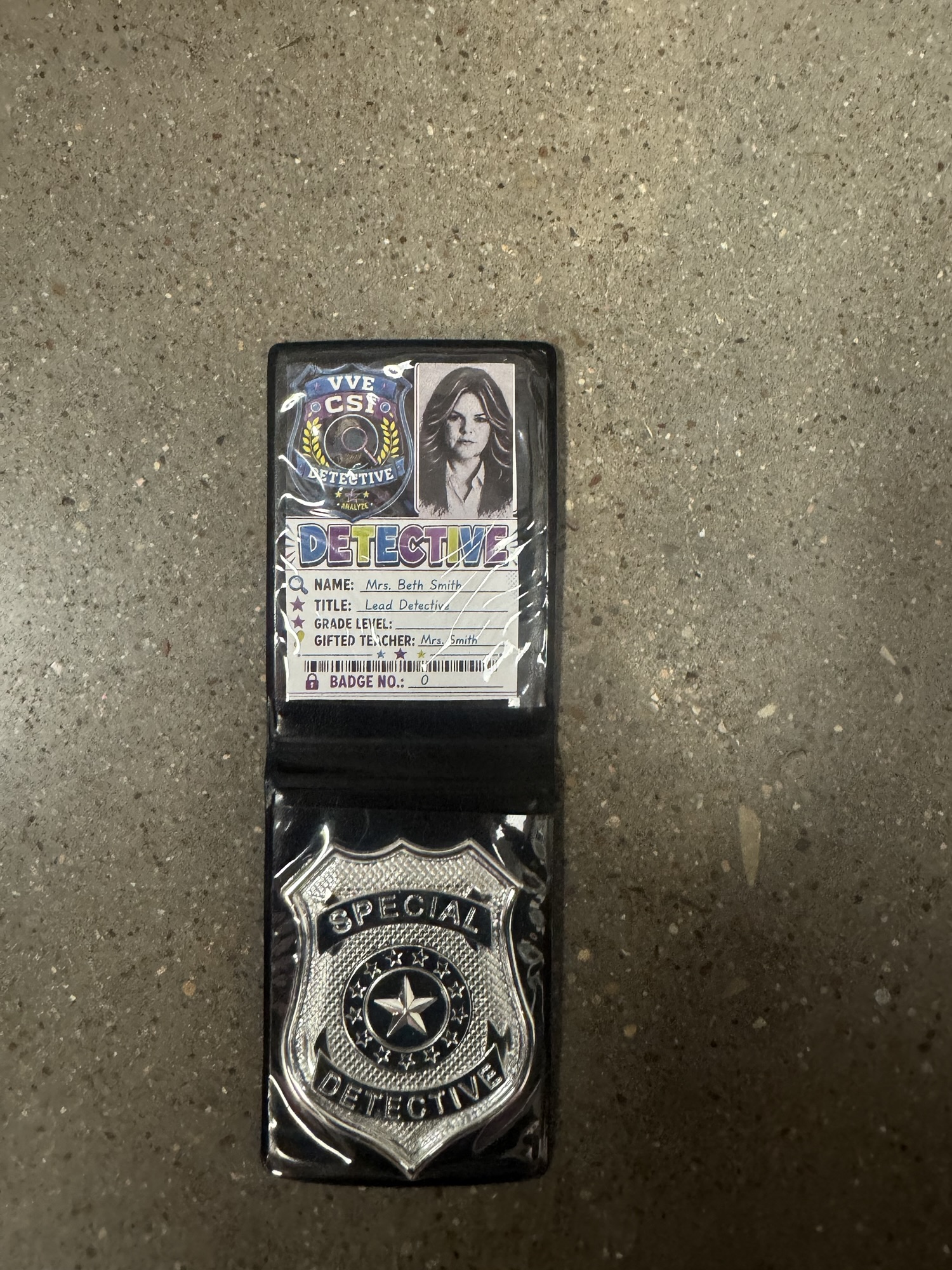
In the gifted classroom, I often ask students to become detectives.

They examine primary sources, investigate the Roswell UFO story, study ocean mystery files, solve BreakoutEDU challenges, and analyze competing explanations. I even use detective badges—not as classroom fluff, but as a reminder that students are expected to observe carefully, ask strong questions, and support their conclusions with evidence.
But what does good detective work actually require?
To help my students answer that question, I am preparing to interview a captain and a sergeant from the Roswell Police Department. I want students to hear directly from professionals who understand that solving a difficult case involves much more than finding one exciting clue.
Real investigators must slow down, notice details, ask purposeful questions, evaluate the reliability of information, consider multiple explanations, and remain patient when an answer is not immediately clear.
Those are also essential skills for gifted learners.
Good Detectives Do Not Begin with a Conclusion
Students are often eager to solve a mystery as quickly as possible. Once they develop a theory, they may begin interpreting every new clue as proof that they are correct.
Gifted students can be especially convincing when this happens. They may build a sophisticated argument around an assumption without first checking whether the evidence actually supports it.
A real detective cannot decide what happened and then search only for evidence that confirms that belief. Investigators must remain open to other explanations, including possibilities that challenge their original thinking.
That is the lesson I want my students to hear from the captain and sergeant: the first answer is not always the best answer, and confidence is not the same as accuracy.
Good detectives ask:
- What did I actually observe?
- What am I assuming?
- How reliable is this information?
- Is there another explanation?
- What evidence would change my mind?
- What do I still need to know?
These questions belong in every classroom investigation.
Bringing Real Investigative Thinking into the Classroom
The officers’ experiences can connect naturally to many of our #smithingifted projects.
During a Roswell UFO investigation, students may encounter witness accounts, photographs, official statements, newspaper articles, and conflicting explanations. Instead of asking only, “What do you think happened?” I can require them to consider who created each source, what that person could reasonably know, and whether another source supports the same claim.
In an ocean mystery file, students might examine an unusual animal adaptation, a sudden ecosystem change, or evidence about an unidentified deep-sea organism. The goal is not to guess the answer first. The goal is to develop a theory that accounts for all the available evidence.
When students work with historical primary sources, they must distinguish between what a document directly states and what they infer from it. They also need to recognize that every source has limitations. A source may be valuable without providing the complete story.
Even a BreakoutEDU challenge requires investigative discipline. Students must observe patterns, communicate discoveries, test possible solutions, and avoid forcing every clue into their first theory.
Across all these activities, the content changes—but the thinking remains remarkably consistent.
Students gather information. They evaluate it. They test explanations. They revise their thinking.
That is authentic inquiry.
A Three-Part Routine for Every Investigation
To make this thinking visible, I use three categories:
1. What We Know
These are facts directly supported by observations, documents, measurements, or other reliable evidence.
Students should be able to point to the exact evidence supporting every statement they place in this category.
2. What We Infer
These are reasonable interpretations based on the evidence.
An inference may be strong, but it is still not the same as a confirmed fact. Students must explain how they moved from the evidence to their conclusion and identify any assumptions they made along the way.
3. What We Still Need to Investigate
These are unanswered questions, missing details, conflicting accounts, or evidence that has not yet been verified.
This may be the most important category because it teaches students that uncertainty is not failure. Sometimes the most intellectually honest conclusion is, “We do not have enough evidence yet.”
This routine can be placed on an anchor chart, added to an evidence board, or used as a three-column investigation sheet. It works with science, history, literature, STEM challenges, robotics troubleshooting, and classroom mysteries.
Before students announce a final conclusion, ask them to review all three columns. Did they confuse an inference with a fact? Did they ignore evidence that challenged their theory? What additional information would make their conclusion stronger?
Teaching Students to Resist the Quick Answer
The most valuable outcome of interviewing real detectives may not be learning how cases are solved. It may be helping students understand the habits required to think responsibly.
Careful thinkers do not rush to judgment.
They do not treat every source as equally reliable.
They do not hide evidence that weakens their argument.
They remain curious, flexible, and willing to revise their conclusions.
Those habits matter far beyond a detective-themed lesson. They help students become stronger researchers, scientists, engineers, historians, readers, and citizens.
A detective badge may make the work feel exciting, but the real goal is much deeper: teaching students to follow the evidence—even when it leads somewhere they did not expect.
What question would your students most want to ask a real detective about solving a difficult case?
#smithingifted

