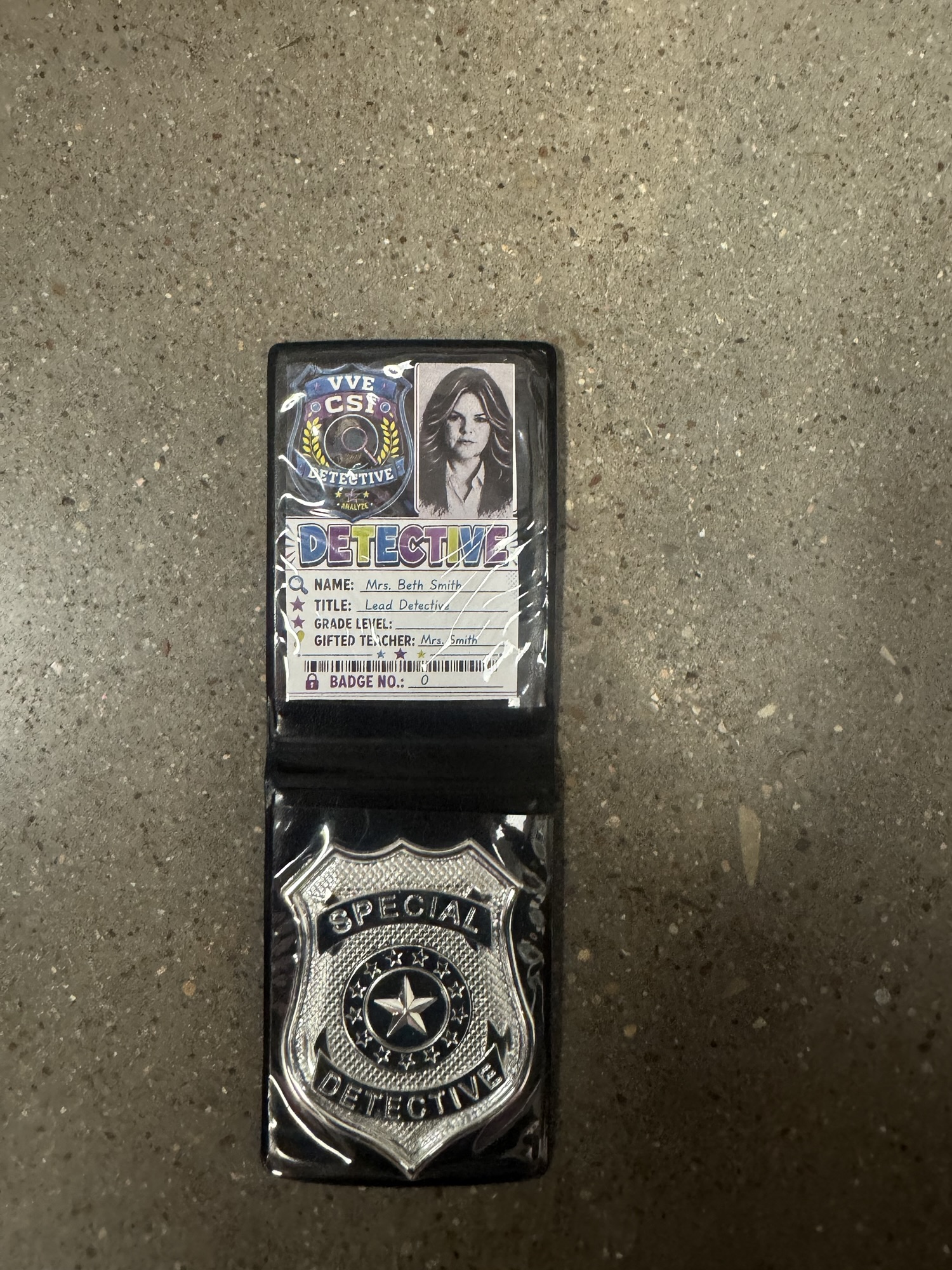
It isn’t classroom fluff. It’s an identity.
By Beth Smith, M. Ed. | #smithingifted
If you’ve ever been in my gifted classroom, you probably know something about me:
I don’t like a lot of fluff.
I’m not interested in adding something to my classroom just because it’s cute. If it takes up space, requires my time, or becomes another thing for me to manage, it needs to have a purpose.
So why in the world am I giving my gifted students Detective Badges?
Oh, let me tell you… 🕵️♀️🔎
Because that little badge represents almost everything I want my students to learn to do in gifted education.
🔎 Gifted Students Should Be Detectives
When students walk into #smithingifted, I don’t want them waiting for me to give them answers.
I want them looking for clues.
I want them asking:
What do I notice?
What doesn’t make sense?
What evidence do I have?
What am I assuming?
How reliable is this information?
Is there another explanation?
What question should I ask next?
That is detective work.
And it is also critical thinking, research, problem solving, analysis, creativity, and gifted education.
The badge gives us a physical reminder of that mindset.
🧠 The Badge Changes the Role
There is something surprisingly powerful about telling a child:
“You’re the detective.”
Suddenly, I’m not the person with all the answers.
They’re responsible for figuring something out.
When students put on their badges, we’re establishing roles:
I’m the facilitator. They’re the investigators.
That tiny shift matters.
Instead of:
“Mrs. Smith, what’s the answer?”
I want:
“Mrs. Smith, look what I discovered!”
That is the classroom culture I’m trying to build.
🕵️ Detectives Don’t Guess. They Use Evidence.
This may be my favorite part.
Gifted students can be incredibly quick thinkers. Sometimes they’re so quick that they jump straight from a question to an answer.
“I know!”
Okay.
How do you know?
😂
That’s where our detective mentality comes in.
A detective can’t simply announce who committed the crime because it feels right.
There has to be evidence.
So whether we’re investigating the Roswell UFO incident, examining primary sources, solving a BreakoutEDU challenge, defending an answer in the 24 Game, analyzing a novel, troubleshooting a robot, or testing an engineering design, the expectation remains the same:
Show me the evidence.
That little detective badge becomes a symbol of intellectual accountability.
🔬 Detectives Notice What Other People Miss
Gifted education should give children opportunities to go beyond the obvious.
A detective doesn’t walk into a room and say:
“Yep. Looks normal.”
A detective looks closer.
🔎 Why is that there?
🔎 What’s missing?
🔎 Do these two pieces of evidence contradict each other?
🔎 Who created this source?
🔎 What might their perspective have been?
🔎 What pattern is developing?
🔎 What happens if we change one variable?
Those are exactly the habits I want my students developing.
Look closer. Think deeper. Ask better questions.
🧩 It Works Across My Entire Curriculum
This is another reason the badges earned their place in my classroom.
They aren’t connected to just one activity.
The detective mindset works almost everywhere.
Students can become history detectives examining primary sources, literary detectives searching a text for evidence, STEM detectives figuring out why a prototype failed, coding detectives debugging a program, math detectives looking for patterns, science detectives analyzing data, and even AI detectives determining whether information is reliable.
The badge doesn’t tell students what to investigate.
It tells them how to think.
And that makes it reusable year after year.
🚨 And Yes…It’s Fun.
I haven’t forgotten that they’re children.
There is something special about opening that badge holder and seeing your name, picture, title, and badge number.
You’re official.
You’re part of something.
You’ve got a job to do.
And when a student feels like they’re entering an investigation instead of completing another worksheet?
I’ll take that win.
The fun isn’t replacing rigorous learning.
The fun is getting them through the door.
Then I can hit them with source evaluation, evidence analysis, CER writing, research, logic, problem solving, and all those wonderfully challenging things I had planned all along. 😉
⭐ That’s Why the Badge Stays.
I’m still not filling my classroom with fluff.
In fact, that’s exactly why I love these badges.
They’re small.
They’re inexpensive.
They’re reusable.
But most importantly, they mean something.
When my students wear a Detective Badge in #smithingifted, I want them to remember:
🔎 Don’t just accept it. Investigate it.
🧠 Don’t just answer. Think about it.
📚 Don’t just claim it. Prove it.
❓ Don’t stop at the first question. Ask another one.
💡 And when something doesn’t work—figure out why.
Because I’m not trying to create students who are really good at waiting for a teacher to tell them the answer.
I’m trying to create investigators.
Curious kids who notice things.
Kids who question.
Kids who research.
Kids who test ideas.
Kids who change their minds when the evidence changes.
Kids who can confidently say:
“Here’s what I think—and here’s the evidence that supports it.”
Now that deserves a badge. 🕵️♀️🔎
#smithingifted #GiftedEducation #GiftedClassroom #CriticalThinking #InquiryLearning #ProblemSolving #StudentEngagement #EvidenceBasedThinking #ElementaryGifted #TeachingGiftedKids

